


Useful Information
This section will contain all the information I believe you may find helpful, whether you're out in the field, getting ready for your first shoot, or looking for details on the equipment you might want to use.
I will share my personal preferences on what I like to use and how I like to prepare.


Technical
Camera
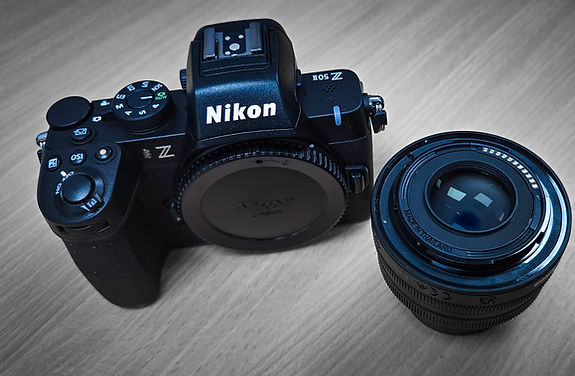
If you’ve been following my recent posts, you know I’ve been obsessed with my new Nikon Z50ii. It’s the successor to the original Z50, which on its own merits had great reviews.
Whether I’m out exploring or just filming at home, this little mirrorless powerhouse has become my go-to for everything.
Let’s talk about the "mirrorless" part first, because it’s a total game-changer. Unlike older DSLRs that use a literal mirror inside, this camera is built without one. This allows it to be much more compact and quiet. The best part? What you see in the electronic viewfinder (EVF) is exactly what your photo will look like, no more guessing if your exposure is right before you hit the shutter.
One of the first things you’ll notice when you pick it up is just how light it is. The body alone weighs roughly 495g, and even with a battery and SD card, it’s only about 550g (roughly 1.2 lbs). It’s small enough to tuck into a small bag, which makes it an incredible travel companion for those of us who don’t want to be weighed down by a massive gear bag.
Technically speaking, it’s packing some serious heat with the EXPEED 7 processor, the same one found in Nikon’s high-end professional cameras like the Z8 and Z9. This means the autofocus is lightning-fast and can automatically recognise nine different types of subjects, from people and pets to birds and even cars. It really takes the stress out of making sure your subject is in focus.
If you’re into videoing too, like I am, you’re going to love the upgrades here. The Z50ii can shoot beautiful 4K UHD video at up to 60p. It also has a new Product Review Mode, which is perfect for vloggers; it smoothly shifts focus from your face to any object you hold up to the lens without any "hunting" or blurring.
For the photo enthusiasts, it features a 20.9MP DX-format sensor. While that might sound similar to the previous version, the new processor improves how it handles low light. With a native ISO range of 100–51,200, you can still get clean, sharp shots even when the sun starts to go down or you’re in a dimly lit room.
Another feature I’m constantly using is the dedicated Picture Control button. It lets you quickly cycle through different colour presets and "recipes" right on the camera. It’s like having Instagram filters built directly into your hardware, so you can see exactly how the "mood" of your shot looks before you even take it.
The ergonomics are also spot on. Nikon gave it a deeper grip compared to the original, making it feel much more secure in your hand. They also swapped the old tilting screen for a fully articulated vari-angle touchscreen, which is a lifesaver for filming yourself or getting those tricky low-angle shots.
Price-wise, it’s surprisingly accessible for the tech you’re getting. You can usually find the Nikon Z50ii body starting around £729. If you’re just starting out, the 16-50mm kit (which is what I started with, basically you get the camera and the lens together in one package) typically ranges from £869 to £999, depending on current deals and retailers.
Overall, the Nikon Z50ii feels like the perfect bridge between being a "beginner" and a "pro". It’s easy enough to use in Auto mode, but it has all the advanced settings I need to grow my skills. I can’t wait to show you more of the photos and videos I’ve been capturing with it!
Lenses
While the camera body is the heart of your setup, it’s the lenses that really bring your vision to life. For my Nikon Z50ii, I’ve been using a specific trio that covers everything from wide-angle street shots to distant wildlife.
Whether you're looking for an all-rounder or a specialist prime, understanding how these NIKKOR Z DX lenses
work will help you get the most out of that 20.9MP sensor.
First up is the NIKKOR Z DX 16-50mm f/3.5-6.3 VR, often referred to as the "pancake" lens. It’s incredibly compact, weighing just 135g, and it retracts into itself when you aren't using it. This is my "walkaround" lens because it fits the 24–75mm full-frame equivalent range, which is perfect for everything from tight interiors to natural-looking portraits.
Technically, this 16-50mm is a bit of a marvel for its size. It features built-in Vibration Reduction (VR) that gives you about 4.5 stops of compensation, meaning you can shoot at slower shutter speeds without getting blurry photos. You can typically pick this lens up on its own for around £299, though it's much cheaper when bundled with the camera body.
When I want that professional "blurry background" look, I reach for the NIKKOR Z DX 24mm f/1.7. This is a "prime" lens, meaning it doesn't zoom, but its wide f/1.7 aperture lets in a massive amount of light. It’s a game-changer for night photography or indoor shots where you don't want to use a flash.
The 24mm prime is also a featherweight at only 135g, making it almost unnoticeable on the Z50ii. Because it’s so fast and sharp, it’s become my favourite for street photography and vlogging, providing a classic 35mm equivalent field of view. It’s also quite affordable, usually retailing for about £199.
For the times I need to get closer to the action, the NIKKOR Z DX 50-250mm f/4.5-6.3 VR is my go-to. This is a proper telephoto zoom that reaches all the way to a 375mm equivalent, which is plenty for capturing birds in the park or athletes on a field. Despite its long reach, it stays relatively light at roughly 405g.
A standout feature of the 50-250mm is its 5-stop Vibration Reduction system. When you're zoomed in all the way to 250mm, even a tiny handshake can ruin a photo, but this tech keeps the image incredibly steady. You can usually find this lens priced around £239, or even less if you buy it as part of a dual-lens camera kit.
All three of these lenses feature a silent control ring. You can customise this ring to adjust things like aperture, ISO, or exposure compensation without making a sound. This is a huge win for video creators, as you won't hear any "clicks" or mechanical noise on your final footage.
The "Z-mount" system on these lenses is actually much wider than the old DSLR mounts. This design allows more light to hit the sensor, resulting in better edge-to-edge sharpness. Plus, because they are DX-format lenses, they are specifically balanced to match the smaller size of the Z50ii perfectly.
Whether you're starting with the 16-50mm kit or adding the 24mm prime for that extra creative edge, these lenses are what make the Z50ii such a versatile tool. I’ve found that having this specific trio means there’s almost no shot I can’t get, from wide landscapes to tight, zoomed-in details.
The "Pancake" Zoom:
NIKKOR Z DX 16-50mm f/3.5-6.3 VR
If you take a photo with the standard kit lens, you'll get a sharp, clear image, but the background will still be quite visible. Because the widest aperture is f/3.5 (at 16mm) and it gets even narrower as you zoom in (f/6.3 at 50mm), it’s harder to get that "creamy" blur.
-
The Look: Great for travel or landscapes where you want the whole scene in focus.
-
The Trade-off: In a portrait, you might still see the details of the trees or buildings behind your subject.
The Prime Specialist:
Switching to the 24mm prime is like flipping a "blur" switch. With a much wider f/1.7 aperture, this lens allows you to physically isolate your subject from the background.
-
The Look: You get a much shallower depth of field. This creates a "bokeh" effect where the background melts away into soft, out-of-focus shapes, making your subject "pop".
-
The Advantage: It’s also significantly better in low light, it lets in over 2 stops more light than the kit lens at the same focal length, which helps keep your photos clean and noise-free even in dark rooms.
The Telephoto Effect:
NIKKOR Z DX 50-250mm f/4.5-6.3 VR
This lens is a "compression" specialist. Even though its maximum aperture is narrower (f/6.3 when zoomed in), the sheer magnification makes distant objects, like a mountain range or a city skyline, look much larger and closer than they appear to the naked eye.
-
The Look: It creates a "cinematic" feel where the background feels like it's looming right behind your subject.
-
The Bokeh: Despite the higher f-number, you still get a shallow depth of field because you are zoomed in so far, which naturally isolates your subject and creates a soft, pleasing blur.
-
The Advantage: It renders faces naturally without the slight distortion you sometimes get with wider lenses, making it an excellent choice for flattering portraits from a distance.
Equipment
Coming Soon...